

CFTC Issues No-Action Relief for Swap Data Reporting Error Corrections

Summary
Situation Overview: On December 10, 2025, the Commodity Futures Trading Commission (CFTC) issued no-action relief regarding the correction of errors in swap transaction and pricing data submitted to a swap data repository (SDR).
What: No-action position taken by the CFTC’s Division of Market Oversight (DMO) in CFTC No-Action Letter 25-43 in response to a request dated September 12, 2025, from the International Swaps and Derivatives Association (ISDA).
Who: Firms required to report swap data to an SDR pursuant to Parts 43 and 45 of the CFTC’s regulations.
In Depth
The Dodd-Frank Act requires all swaps to be reported to an SDR in accordance with the CFTC’s regulations, as described under Parts 43 and 45.
Part 43 requires firms to report swap data in real time after execution to be publicly disseminated by the SDR. Part 43-reportable data includes time of execution, the dates the swap becomes effective and expires, the notional amount, and the price, among other information required by the CFTC, as listed in Appendix A to Part 43, as well as data required by the firm’s SDR.
Part 45 requires firms to report swap creation and continuation (e.g., amendments, assignments, and terminations) data to an SDR no later than the business day following the swap’s execution (or two business days for non-swap dealer firms). Part 45-reportable data includes all Part 43-reportable data, as well as additional data regarding the swap’s counterparties, product-specific details, and other information required by the CFTC and the firm’s SDR. Part 45 also requires swap dealer firms to report daily valuation and collateral data for all open swaps.[1]
CFTC Regulations 43.3(e) and 45.14(a) require firms to correct historical errors in reported swap data or to retroactively submit data for swaps that were erroneously not reported (i.e., corrective reporting or backreporting). This includes swaps that have “terminated, matured, or otherwise [are] no longer considered to be a swap”[2] (dead swaps). In some cases, compliance requires firms to submit corrections for swaps that ceased to exist prior to significant CFTC reporting rule amendments that substantially change the data elements required to be reported. In such cases, firms may have to retrieve or infer data that they were not required to maintain at the time the swap was open. ISDA’s request refers to the date of such amendments as “Last Change Date.”
Firms interpret Part 45 to require correction of all data previously submitted to the SDR, not just the most recently submitted data.[3] Consequently, for example, if a firm discovers an error in its daily valuation calculation, it must correct the valuation data reported for every single day since the swap’s execution.
Corrections Subject to No-Action Relief
To reduce the regulatory burden on those reporting, DMO agreed to take no-action positions pursuant to ISDA’s request. Specifically, DMO will not recommend an enforcement action against firms that do not perform corrective reporting in the instances below.
For Part 43 reporting, the relief covers
- Errors in data fields other than those required under Part 43 (listed in Appendix A to Part 43); and
- Errors (regardless of whether listed in Appendix A to Part 43) that occurred prior to:
- The Last Change Date for Part 43,[4] or
- One year before the error’s discovery.
For Part 45 reporting, for Dead Swaps, the relief covers
- Swaps that became “dead” prior to:
- The Last Change Date for Part 45,[5] or
- Two years prior to the error’s discovery; and
- Any other Dead Swaps not included in the above, unless the error impacts data fields required under Part 43, a field containing a Legal Entity Identifier (i.e., LEI, used to identify the swap’s counterparties), or the Unique Transaction Identifier field (i.e., UTI).[6]
For Part 45 data for open swaps, the relief covers any historical data other than the most recently reported data for that swap. For example, for a valuation error, firms would only be required to correct the swap’s valuation data for the most recent daily submission.
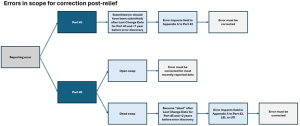
The chart below depicts the conditions under which swap reporting errors are still subject to correction. Errors that do not meet these conditions are covered under the no-action relief described above.
Next Steps
Given this no-action relief, firms may need to evaluate their plans for correcting existing errors and their processes for correcting errors going forward. For example, firms should consider the following with respect to identified reporting errors:
- Whether the error impacted submissions pursuant to Part 43, Part 45, or both;
- Which of the impacted swaps are currently open, or if dead, how long each swap has been dead; and
- Whether the error impacted data fields included in Appendix A to Part 43, and for Part 45 data, whether it impacted an LEI and/or the UTI.
Based on this information, firms can determine the extent of corrective reporting required for each identified reporting error. The no-action relief may also allow firms to refocus SDR reporting resources on correcting data for recent and open swaps and preventing reporting errors going forward.
Put Patomak’s Expertise to Work
Patomak has worked with firms to develop and enhance their SDR reporting programs, including processes for identifying and resolving reporting errors and managing high volumes of open and dead swaps requiring correction. Patomak welcomes discussions with firms that may need to evaluate or enhance their swap reporting programs in light of recent regulatory developments. To learn more or discuss how Patomak can support your firm, please contact Sudhir Jain at sjain@patomak.com, Anne Montminy at amontminy@patomak.com, Tim Brown at tbrown@patomak.com, and Drew Godsell at dgodsell@patomak.com.
[1] “Open swap means an executed swap transaction that has not reached maturity or expiration, and has not been fully exercised, closed out, or terminated.” 17 C.F.R. § 45.1(a).
[2] 17 C.F.R. § 43.3(e)(1); 17 C.F.R. § 45.14(a)(1).
[3] Letter from C. Young to R. Varma re: Request for a No-Action Position Concerning Error Correction Rules (Sept. 12, 2025), available at https://www.google.com/url?sa=t&rct=j&q=&esrc=s&source=web&cd=&cad=rja&uact=8&ved=2ahUKEwjs87SBy8CRAxXhv4kEHTPtA-MQFnoECCcQAQ&url=https%3A%2F%2Fwww.cftc.gov%2Fcsl%2F25-43%2Frequest_letter%2F0%2Fdownload&usg=AOvVaw0OdACmOnS_9WNYKMW2i3Ux&opi=89978449.
[4] For Part 43, DMO’s no-action position incorporates ISDA’s reference to Last Change Date as “the effective date of (i) the most recent change to the Part 43 rules that affects the content or format of the data required to be reported, or (ii) the most recent technical specification for the applicable asset class published pursuant to regulation 43.7(a)(1).”
[5] For Part 45, DMO’s no-action position incorporates ISDA’s reference to Last Change Date as “the effective date of (i) the most recent change to the Part 45 rules that affects the content or format of the data required to be reported or (ii) the most recent technical specifications for the applicable asset class published pursuant to regulation 45.15.”
[6] The Unique Product Identifier (UPI) field listed in Appendix A to Part 43 has not yet been implemented for the commodities asset class. Thus, DMO notes that corrective reporting would instead be required in this instance for repository-specific fields that firms report in lieu of UPI for commodity swaps.


